gen_mqtt_service
Generate MQTT service
Project maintained by vroncevic Hosted on GitHub Pages — Theme by mattgraham
The MQTT protocol
MQTT is a publish/subscribe messaging protocol designed for lightweight M2M communications. It was originally developed by IBM and is now an open standard.
Architecture
MQTT has a client/server model, where every sensor is a client and connects to a server, known as a broker, over TCP.
MQTT is message oriented. Every message is a discrete chunk of data, opaque to the broker.
Every message is published to an address, known as a topic. Clients may subscribe to multiple topics. Every client subscribed to a topic receives every message published to the topic.
Network entities
MQTT defines two types of network entities:
- message broker, and
-
number of clients
- Mosquitto ===> C Client (
libmosquitto) and Broker (C11, high-performance) - Paho MQTT ===> Python Client (Clean Architecture, SOLID, typing protocols)
- Node MQTT ===> JavaScript/Node.js Client (
mqtt, asynchronous event-driven) - Node WS ===> JavaScript WebSocket Client with embedded Aedes broker
An MQTT broker is a server that receives all messages from the clients and then routes the messages to the appropriate destination clients. An MQTT client is any device (from a micro controller up to a fully-fledged server) that runs an MQTT library and connects to an MQTT broker over a network.
Information is organized in a hierarchy of topics. When a publisher has a new item of data to distribute, it sends a control message with the data to the connected broker. The broker then distributes the information to any clients that have subscribed to that topic. The publisher does not need to have any data on the number or locations of subscribers, and subscribers, in turn, do not have to be configured with any data about the publishers.
If a broker receives a message on a topic for which there are no current subscribers, the broker discards the message unless the publisher of the message designated the message as a retained message. A retained message is a normal MQTT message with the retained flag set to true. The broker stores the last retained message and the corresponding QoS for the selected topic. Each client that subscribes to a topic pattern that matches the topic of the retained message receives the retained message immediately after they subscribe. The broker stores only one retained message per topic. This allows new subscribers to a topic to receive the most current value rather than waiting for the next update from a publisher.
When a publishing client first connects to the broker, it can set up a default message to be sent to subscribers if the broker detects that the publishing client has unexpectedly disconnected from the broker.
Clients only interact with a broker, but a system may contain several broker servers that exchange data based on their current subscribers’ topics.
A minimal MQTT control message can be as little as two bytes of data. A control message can carry nearly 256 megabytes of data if needed. There are fourteen defined message types used to connect and disconnect a client from a broker, to publish data, to acknowledge receipt of data, and to supervise the connection between client and server.
MQTT relies on the TCP protocol for data transmission. A variant, MQTT-SN, is used over other transports such as UDP or Bluetooth.
MQTT sends connection credentials in plain text format and does not include any measures for security or authentication. This can be provided by using TLS to encrypt and protect the transferred information against interception, modification or forgery.
The default unencrypted MQTT port is 1883. The encrypted port is 8883.
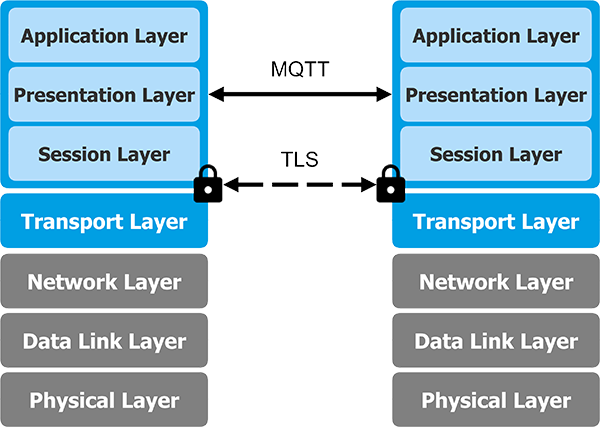
Protocol support more details.
Implementation and Templates Guide
To generate client and service skeletons for any of these architectures, see the Templates Architecture & Usage Guide.